Bryce Canyon National
Park - Utah
 Ebenezer
Bryce, so-called discoverer of the canyon that bears his name,
is reported as classifying it as "a hell of a place to lose a
cow." There are a couple of things that don't strike me right
about the above. One is that the area that Bryce "discovered"
certainly was seen and known by other human beings long before
Ebenezer, and the other is that for hordes of people who have
visited, the scenic oddity and beauty of Bryce Canyon National
Park have engendered thoughts more profound than those
attributed to Mr. Bryce. Ebenezer
Bryce, so-called discoverer of the canyon that bears his name,
is reported as classifying it as "a hell of a place to lose a
cow." There are a couple of things that don't strike me right
about the above. One is that the area that Bryce "discovered"
certainly was seen and known by other human beings long before
Ebenezer, and the other is that for hordes of people who have
visited, the scenic oddity and beauty of Bryce Canyon National
Park have engendered thoughts more profound than those
attributed to Mr. Bryce.
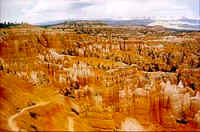
Bryce is truly a
wonderland of nature's erosive handiwork, a vast array of
fingers, spires and pinnacles, all of rosy hue, carved into
fantastic shapes, some extremely delicate, others massive and
sturdy, such as the well-named "Thor's Hammer."
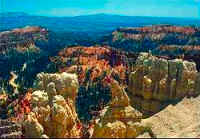 Of the
many overlooks, Sunrise and Sunset are the two most sought
out. Trails from them lead to such features as the above
mentioned Hammer, Queens Gardens, where a natural rock
likeness of Queen Victoria holds sway, and the soldier-like
figure, the Sentinel, and Tower Bridge. The Navajo Trail, with
"Wall Street" at the bottom, looks and is easy going down, but
the return climb is another matter. At an altitude of about
8,000 feet, visitors used to lower places, such as sea level,
find that just breathing becomes a great effort. Of the
many overlooks, Sunrise and Sunset are the two most sought
out. Trails from them lead to such features as the above
mentioned Hammer, Queens Gardens, where a natural rock
likeness of Queen Victoria holds sway, and the soldier-like
figure, the Sentinel, and Tower Bridge. The Navajo Trail, with
"Wall Street" at the bottom, looks and is easy going down, but
the return climb is another matter. At an altitude of about
8,000 feet, visitors used to lower places, such as sea level,
find that just breathing becomes a great effort.
A notable feature of
the Bryce Canyon National Park scenery is the change of colors
with the time of day and angle of the view. Cross-lighting, as
the sun drops lower in the sky, can cause the rosy rock to
glow.
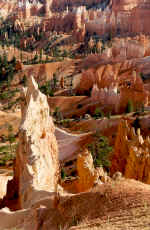 Nature's
tools for forming the odd scenery at Bryce are rain, snow,
wind and temperature changes. When ice forms in the cracks and
crevices of the relatively young and friable rock formations
of Bryce, it expands with terrific force and breaks the rock.
A good example of Bryce's fast erosion is the Wall of Windows,
in which old openings are crumbling, and new ones forming
unusually rapidly. Nature's
tools for forming the odd scenery at Bryce are rain, snow,
wind and temperature changes. When ice forms in the cracks and
crevices of the relatively young and friable rock formations
of Bryce, it expands with terrific force and breaks the rock.
A good example of Bryce's fast erosion is the Wall of Windows,
in which old openings are crumbling, and new ones forming
unusually rapidly.
Away from the
scenic glory of the canyon edge in Bryce Canyon National Park,
are forests and meadows, rife with wildlife, both flora and
fauna. There are Bristle cone Pines, as old as 1700 years, and
many wild blossoms in their season. As for animal life, there
are mule deer, prairie dogs, and chipmunks that seem always to
be hungry. The last time I was there, we saw a wild turkey
right on the road.
The National Park has lodging and
campgrounds. Horseback trips can be arranged at the lodge. One
thing Bryce doesn't have is sufficient parking area for the
constantly growing stream of visitor's vehicles. In June of
2000 the Park implemented a shuttle system in an effort to
eliminate congestion, minimize damage to fragile resources,
and restore serenity and natural quiet which are integral to
the Bryce Canyon experience. The Shuttle is a convenient,
user-friendly way to see the park, and best of all, it's FREE
with the purchase of a park entrance pass!! The shuttle
is optional and few people realize it is cheaper to ride the
shuttle than to drive into the park. A 7-day park entrance
pass including unlimited use of the shuttle unlimited use of
the shuttle Driving your own car into the park costs
$20. The shuttle operates May 15 through September 30,
and makes stops at the various viewpoints approximately once
every 10-15 minutes.
To reach Bryce
Canyon from Kanab, go north on Hwy 89 for 65 miles and turn
right on Hwy 12 into the park. Note: if it's your first visit,
don't be fooled by Red Canyon, which you will pass first. Red
Canyon is very scenic in its own right, but it's
an opening act, not the main feature.
|


